
Navigating Quiet Zones on the GCL
Did you know that under the Train Horn Rule of 2006, federal regulations require locomotive horns to be sounded for 15 to 20 seconds and not more than one-quarter mile in advance of entering public grade crossings? It’s true!
What is a quiet zone?
While the Train Horn Rule established the requirement for sounding of locomotive horns, another federal procedure implemented quiet zones. Localities that meet certain safety requirements can apply for a “Quiet Zone” segment of a rail line that has multiple crossings on a public roadway. Upon meeting technical requirements, locomotive horns will not be routinely sounded within a quiet zone.
How are quiet zones achieved?
Neighborhoods that want to establish a quiet zone are first required to address the heightened safety concerns resulting from the discontinuance of horn usage. Examples of these measures include:
What is a four-quadrant gate?
Safety is a top priority for the GCL. Four-quadrant gates will protect pedestrians and vehicle passengers. They block the road leading away from railroad tracks in both directions during a train crossing. Sidewalk crossings are barred with gates too. Why is this significant? It prevents people and cars from illegally trying to bypass the train tracks when an approaching train is coming from the distance.
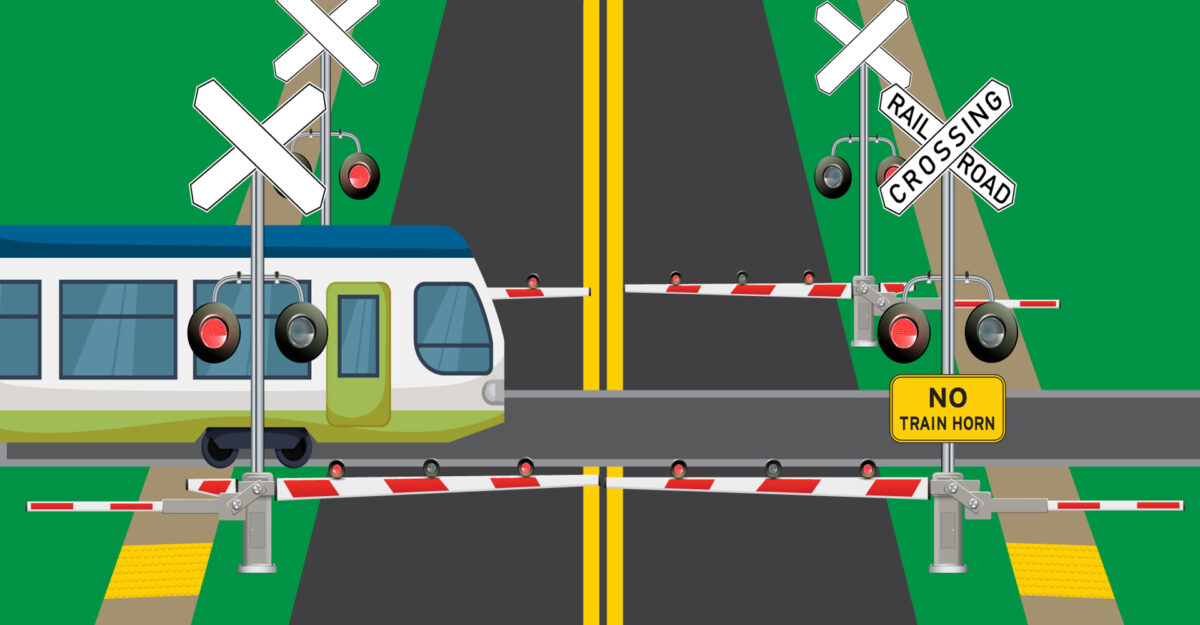
Quiet Zones on the GCL
The GCL Project Team is committed to the design and future investment of the installation and maintenance of all Quiet Zone infrastructure along the GCL alignment. All grade crossings are being designed to accommodate quiet zone crossings through the installation of four-quadrant gates or the utilization of raised medians.
The communities along the corridor will benefit from Quiet Zones by achieving enhanced safety standards while reducing the need for train operators to sound horns in advance of the crossings.
The GCL Project Team is working with NJDOT and FRA to confirm the Quiet Zone designation process and related logistics. More information and details on the Quiet Zone will be addressed during PED and DBOM phases.
Example Quiet Zone Crossing with Safety Features
The video below shows a crossing in Anaheim, California, equipped with similar features planned for the GCL project. While the GCL will utilize shorter trains and faster gate operation for smoother traffic flow, the core safety principles remain the same.
Quiet Zone Process Timeline
Party Involvement Key

Step 1: Confirm Quiet Zone Eligibility and Limits
Lead: GCL Team
The proposed Quiet Zones are defined and it is confirmed that all public crossings will be equipped with FRA‑approved Supplementary Safety Measures (SSMs), allowing public authority designation.
This includes:
- Identifying Quiet Zone limits and participating municipalities
- Confirming all public crossings qualify for SSM‑based designation
- Grouping adjacent crossings under a single Quiet Zone where appropriate

Step 2: Design and Implement SSMs
Lead: GCL Team and Design-Build-Operate-Maintain (DBOM) Contractor
Engineering design and construction are completed for all SSMs required at public crossings within the proposed Quiet Zone.
This includes:
- Final design and construction of SSMs at all crossings compliant with FRA and Manual on Uniform Traffic Control Devices (MUTCD)


Step 3: Install Required Quiet Zone Signage
Lead: GCL Team
All FRA‑required Quiet Zone signage is installed at each public crossing in accordance with federal regulations.
This includes:
- Installing signage per 49 CFR 222
- Verifying signage placement and visibility at each public crossing
Step 4: Update the National Grade Crossing Inventory
Lead: GCL Team
The USDOT National Grade Crossing Inventory is updated to reflect current conditions at all public and private crossings within the Quiet Zone.
This includes:
- Updating inventory records for public and private crossings
- Documenting installed SSMs and operational characteristics
Step 5: Quiet Zone MOU Coordination
Lead: GCL Team
Memorandum of Understanding to be developed for each Quiet Zone.


Step 6: Notify Required Parties and Establish the Quiet Zone
Lead: GCL Team
The FRA is notified and other required parties of Quiet Zone establishment, after which the Quiet Zone becomes effective if no objections are raised.
This includes:
- Issuing notification per 49 CFR 222 to FRA, NJDOT, railroads, emergency responders, and adjacent jurisdictions
- Publishing and distributing the Notice of Establishment
- Quiet Zone becoming effective automatically following the review period
- Submitting updated inventory information to FRA every 4.5–5 years to maintain designation
Clarifying Notes
A Quiet Zone limits routine horn use at grade crossings only; it is not a silent zone. Locomotive horns and bells are required at stations, in rail yards, when approaching workers or equipment, when passing standing trains, or in emergency situations.